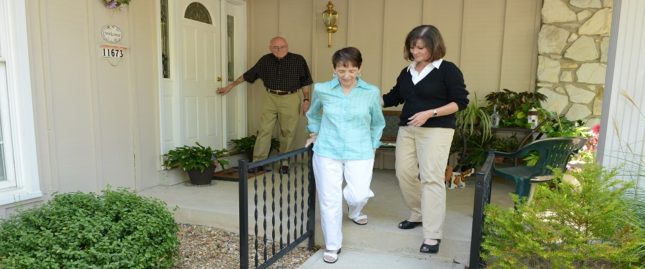
The I-HOPE targets activities performed in the home that are essential for aging in place. The purpose of the assessment is to measure the effects of an incompatibility between a person’s abilities and the environment, or the “person-environment misfit” of older adults and their homes.
The I-HOPE helps occupational therapists measure clients’ in‐home activity performance and observe changes in person‐environment fit before and after home modification interventions.
The I-HOPE offers a psychometrically sound assessment of daily activities that considers the client’s perspective and satisfaction while recognizing the role of the environment in performance.
We developed the I-HOPE in response to the lack of performance‐based assessments that evaluate function in relation to the environment.
Jump to ordering information »
How it works
The I-HOPE is a multi-step assessment conducted in the client’s home by a trained rater. The I-HOPE takes approximately 60 minutes to conduct and requires no specialized equipment beyond the materials included in the kit.
Materials include:
- Manual
- Assessment forms
- Barrier list
- Activity cards
- Response cards
- Summary score sheets
Three easy steps
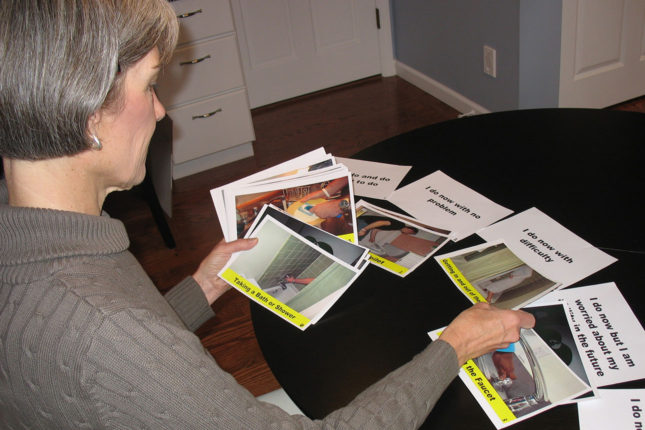
Step 1:
An assessment of current in-home activities is conducted using a set of 44 cards of images depicting older adults participating in daily activities. An overall score for activity performance is then calculated.
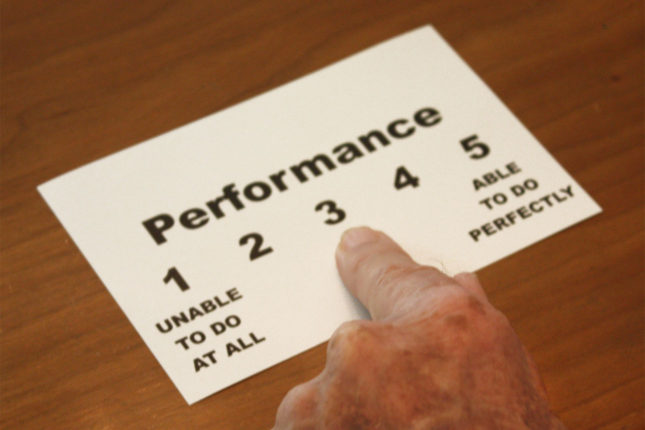
Step 2:
Priority activities are identified for intervention and given a subjective performance and satisfaction score.
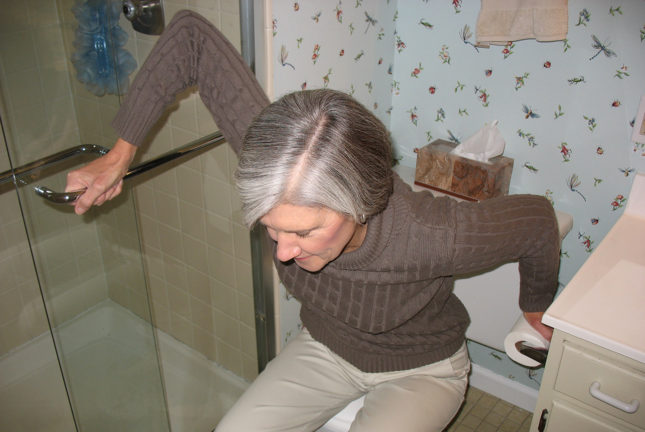
Step 3:
Performance-based rating of barriers’ influence on performance
Understanding the results
The I-HOPE yields four subscores that can be used individually or as a profile of performance.
- The Activity score measures the proportion of problematic activities. It is calculated by dividing the total number of activity difficulty scores by the number of activities the client wants to do.
- The Performance score measures the client’s subjective performance of prioritized problematic daily activities and consists of the mean performance rating for these activities.
- The Satisfaction score measures the client’s subjective satisfaction with their performance of prioritized problematic activities. It consists of the mean satisfaction rating for these activities.
- The Total Barrier Severity score is the interviewer’s rating of person-environment fit through a performance-based assessment of problematic activities. It consists of the sum of each rating.
Training
Complimentary online training videos are available upon request with the purchase of the I-HOPE assessment. To access the videos, email peplab@wustl.edu after your purchase.
How to order
NOTE: A signed copyright notice is required before we can process your order. Please download and sign the copyright form (PDF), and return it to us at peplab@wustl.edu. Directions for signing documents using Adobe software can be found on the Adobe website.
To order the I-HOPE online using a credit card, click on the button below.
To order the I-HOPE using tax-exempt status, by purchase order, or by check, please email peplab@wustl.edu.
Supporting information
Use of the I-HOPE in practice:
For additional information on the development of the I-HOPE, see our publication in the American Journal of Occupational Therapy.
Funding was provided by a National Institutes of Health Grant K07AG21164–02 and National Institutes of Health Multidisciplinary Clinical Research Career Development Awards UL1RR024992 and K12RR023249.