Overview
Target audience: Individuals with a plan to discharge home after inpatient stroke rehabilitation
Outcomes: Reintegration to home and community living
Delivered by: Occupational therapist
Professional required: Occupational therapist
Program type and format: 1:1 intervention in the home
Length: One predischarge home visit (~75 min), four post-discharge visits (~75 min), one or two booster visits (~ 60 min) 4-5 months post-discharge
Setting: Home and community
Funding note: National Center for Medical Rehabilitation Research grant #1611R03HD079841-01A1.
Introduction
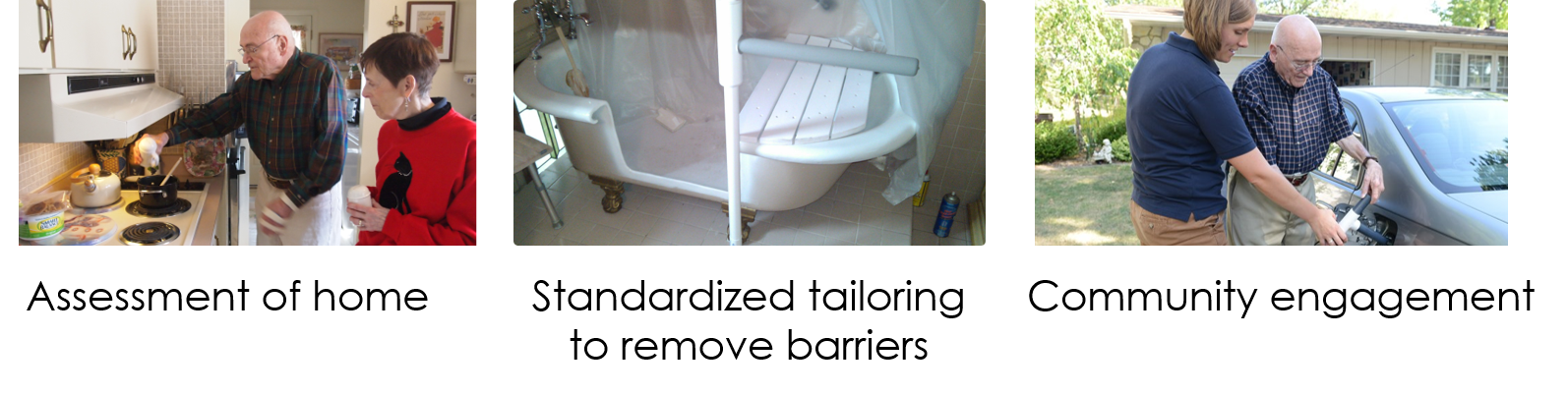
Community Participation Transition after Stroke (COMPASS) is an occupational therapy intervention for people discharging home from inpatient rehabilitation (IR) after stroke. COMPASS is delivered by an occupational therapist and includes visits to the client’s home to resolve environmental barriers that impact safety, daily activity performance, and community participation. The intervention consists of one home visit prior to discharge, four post-discharge home visits, and one or two booster visits 4-5 months post-discharge.
The intervention
The client and the occupational therapist identify up to 10 in-home problems that make completing activities difficult. Then they identify three possible modifications or strategies to resolve each barrier, select and implement the solutions, and practice doing the activity with the new modification or strategy. The client also identifies two barriers to community participation, and together with the occupational therapist, uses problem solving and action planning to address the barriers.
How it works
The essential components of COMPASS are home modification and self-management. The participant identifies problems in the home, and barriers are resolved. Self-management includes client-centered active problem solving to identify problems in the home and community and to engage in action planning.
The active components include:
- Tailoring to address the client’s functional loss, risk factors, and home environment
- Motivational enhancement to resolve ambivalence and make decisions about changes.
- Shared decision making to provide structure to the client in selecting best barrier removal strategy.
Training
Please email us at peplab@wustl.edu for information on COMPASS training.
Evidence
Publications describing studies of COMPASS:
- Process evaluation of a randomized controlled trial of an enhanced rehabilitation transition program for stroke survivors
- Community Participation Transition After Stroke (COMPASS) Randomized controlled trial: Effect on adverse health events
- Rehabilitation transition program to improve community participation among stroke survivors: A randomized clinical trial
- Trial protocol available in the supplementary materials
- Effect of a novel transition program on disability after stroke: A trial protocol
- Feasibility of a novel intervention to improve participation after stroke
Additional Resources
Clinical Reasoning Guideline for Home Modification Interventions
In-Home Occupational Performance Evaluation
Funding
Funding for the development of COMPASS was provided by a National Center for Medical Rehabilitation Research grant (1611R03HD079841-01A1).